


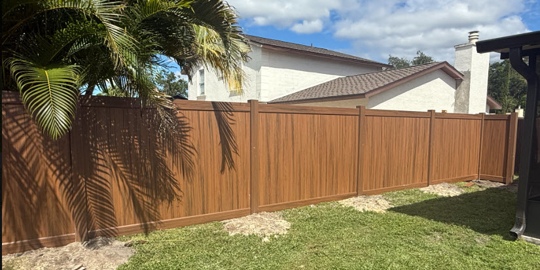
Wood, vinyl, and aluminum each have a job they do best. Here is how to match the right fence to your yard, your goals, and the Florida climate.
There is no single best fence. There is a best fence for what you actually want, and the three materials we install each shine in different situations. The trouble most homeowners run into is shopping by material first, when the smarter move is to start with the goal and let that point you to the material. Here is a plain breakdown to help you figure out which one fits your yard and your life.
Wood: warmth and privacy at a friendly price
Wood gives you that classic, solid, full-privacy look, and it is usually the most budget-friendly way to enclose a yard. There is a reason it has been the default for so long. It feels warm, it blocks sightlines completely, and it is easy to customize with different heights and picket styles.
The trade is upkeep. Florida sun and humidity are genuinely hard on wood. Left alone, boards dry out, gray over time, and can warp. None of that is a dealbreaker, it just means wood asks a little of you. A coat of quality sealant every couple of years keeps the sun from drying the boards out and keeps the color looking fresh. If you like the natural look and do not mind a modest maintenance habit, wood is a great pick and the easiest on the wallet up front.
Vinyl: low maintenance and clean lines
Vinyl is the set-it-and-forget-it option. It will not rot, it does not need sealing, and it shrugs off the humidity that wears on wood. When it gets dirty, a rinse with the garden hose handles most of it. It gives you the same full privacy as wood with a crisp, uniform look that stays put.
It costs more than wood up front, and that is the honest tradeoff. What you are buying with that extra cost is years of not thinking about your fence. For a lot of homeowners, especially anyone who would rather spend the weekend in the yard than working on it, vinyl earns its price back in saved effort. If you want full privacy and near-zero maintenance, this is usually the one.
Aluminum: open, elegant, and tough on rust
Aluminum is the material to reach for when you want to define a space without closing it off. Think framing a garden, lining a walkway, or keeping a clean sightline across the yard. It has an elegant, almost wrought-iron look without the iron, which matters here because aluminum will not rust the way iron does. In our humidity, that rust resistance is a real advantage, and the heat does not bother it at all.
The one thing to be clear about is that aluminum is not a privacy fence. You can see through it, by design. So think of it as structure, security, and curb appeal rather than a wall. Used for the right job, it looks sharp and lasts a long time with almost no upkeep.
Start with the goal, not the material
Here is the simplest way to choose. Forget the materials for a second and finish this sentence: the main thing I want from this fence is _____. Then match it:
- Privacy on a budget. Wood is usually your answer. Full coverage, friendly price, a little upkeep.
- Privacy with no fuss. Vinyl. You pay more once and then mostly leave it alone.
- Curb appeal and an open feel. Aluminum. Structure and looks without boxing in the view.
- Security without blocking the view. Aluminum again, especially around the front of the property.
You are allowed to mix
Nothing says the whole yard has to match. Plenty of Tampa homes run vinyl or wood along the back and sides for privacy, then switch to aluminum across the front for looks and an open feel. You get privacy exactly where you want it and openness where you do not, all in one design. If your yard has different jobs in different spots, mixing materials is often the smartest, best-looking answer.
A few Tampa-specific things to keep in mind
Our climate is part of the decision, so factor these in before you commit:
- Sun and humidity. They age wood faster than almost anything, which is why sealant matters. Vinyl and aluminum are far more hands-off in this regard.
- Heavy summer rain. Whatever the material, the install has to handle soggy ground, which comes back to posts set deep and in concrete.
- HOA and neighborhood rules. Some communities have specific requirements on height, style, or material. It is worth a quick check before you fall in love with a look.
What about how long each one lasts?
A reasonable question before you choose is how long you can expect each material to hold up. With proper installation and basic care, all three are built for the long haul. Wood, kept sealed, lasts many years, though it is the one most affected by sun and moisture over time and the one that asks for the most attention. Vinyl resists rot and weather, so it tends to keep its look for a long stretch with very little intervention. Aluminum is extremely durable and rust-resistant, which makes it one of the most low-maintenance, long-lived options for the jobs it suits. The honest headline is that for any of the three, install quality affects lifespan as much as the material does, which is why we keep circling back to that point.
The material is only half the fence
Whatever you land on, remember that the install matters as much as the material. A premium fence set on shallow posts is still a shallow-post fence. Every fence we put in goes in Stand Strong Certified and is backed by a lifetime workmanship warranty, so the part you cannot see is held to the same standard as the part you can. The best material in the world cannot make up for a rushed install, and a great install makes any of these three materials last.