


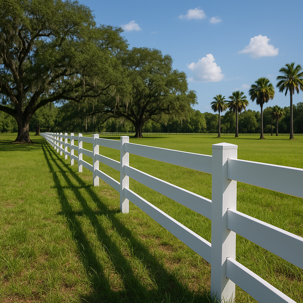
A fence lives or dies at the posts. Here is what separates a fence that lasts from one that leans, and why the part you cannot see matters most.
Most people judge a fence by the part they can see. The panels, the color, the height. That is fair enough, because that is the part you live with every day. But if you want to know whether a fence will still be standing dead straight in ten years, you have to look at the part you cannot see at all. The posts.
Here is the simple truth that the fence world does not always advertise. Panels are the easy part. Posts are the whole job. Get the posts right and almost everything else falls into place. Get them wrong and no amount of nice paneling will save you.
Depth does the heavy lifting
A post that is not buried deep enough has nothing to push back with. When the ground shifts, when the soil gets soggy after a week of summer rain, when a strong wind leans on the fence line, a shallow post has no leverage to resist it. Set the post deep, and the fence has a real foundation. Set it shallow to save time and material, and you get a fence that starts to lean a season or two later.
This is the frustrating thing about post depth. You cannot see it after the job is done. The fence looks identical on install day whether the posts went deep or barely went in at all. The difference only reveals itself with time, which is exactly why it is the easiest corner to cut and the most expensive one to discover later.
Concrete is the anchor, not an upgrade
Setting posts in concrete locks them in place so they are not just sitting in loose dirt waiting to move. Some bids treat concrete like an optional extra. We treat it like part of the job, because in our sandy, rain-soaked Florida ground, that anchor is what keeps a fence line straight instead of slowly going crooked. Sandy soil drains and shifts. A post planted in it with no concrete is a post on the move, just slowly enough that you do not notice until the lean is obvious.
Spacing is quietly important
Posts that are spaced too far apart force the panels between them to carry weight they were never designed to carry. Over time those long unsupported runs start to sag and bow in the middle. Proper spacing means each section is held up the way it should be, so the fence stays flat and even down the whole line.
Here is the part worth knowing as a buyer. Fewer posts is cheaper to install, because it is less digging, less concrete, and less material. So when you see a low bid, wider post spacing is one of the first places that savings tends to come from. It looks fine at first and shows up as sag later.
How to spot good post work
You do not have to climb in the hole to tell whether the posts were done right. A few things to look for and ask about:
- Ask how deep the posts go and whether they are set in concrete. A straight answer is a good sign.
- Look down the finished fence line from one end. It should be dead straight, with even gaps between sections and no waves or dips.
- Push gently on a few posts. A solid post does not budge. A little wiggle on a brand-new fence is a red flag.
- Check the spacing. Evenly spaced posts at sensible intervals are doing their job. Long gaps are a place sag will eventually appear.
Signs your current fence has a post problem
If you already have a fence and are wondering whether it was built right, the posts will usually tell on themselves:
- Sections that lean or lean a little more after every storm.
- Panels that sag or bow in the middle of a run.
- A gate that used to latch cleanly and now drags or misses, often because the post it hangs on has shifted.
- Posts you can rock back and forth by hand.
Caught early, some of this is a repair. Left alone, it tends to become a replacement, because once a few posts go the rest of the fence is working harder to compensate.
Gates are really a post problem in disguise
It is worth singling out gates here, because a gate hangs all of its weight and all of its daily use on a single post, swinging open and shut hundreds of times a year. If that post is not set deep and anchored in concrete, the gate is the first thing to start sagging, dragging, or missing the latch. So when folks tell us their gate has gone wonky, the fix usually starts at the post, not the gate itself. A gate that still latches cleanly years later is almost always sitting on a post that was set right from the start. That is why we give gate posts extra care on every job. They are the hardest-working posts in the whole fence, so they get the attention to match.
Why we do not cut corners underground
This is the whole reason a cheap fence and a solid fence can look identical the day they go up and look nothing alike two years later. The difference is underground, in the part nobody photographs. Stand Strong Certified installation means the posts go in to a real standard every time, set in concrete, spaced right, and dug to the proper depth. And because we back the work with a lifetime workmanship warranty, we are not just hoping it holds. We are on the hook to make sure it does, which is a strong incentive to get the hidden part right the first time.