


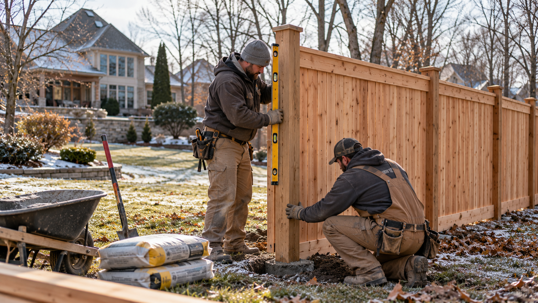
Every October, the same question shows up in our inbox and on our estimate calls. The leaves are coming down across Carmel, the evenings are cooler, and homeowners who meant to put up a fence this summer are wondering if they missed their chance. The good news is that winter fence installation in Indiana is very doable, and in a lot of cases the cooler months come with real advantages. The catch is that a Central Indiana winter changes how the work gets done, and the timing of your project matters more than most people expect.
I'm Sean Kennedy, owner of Stand Strong Fencing of Indianapolis. I meet a lot of our customers in person, and this time of year I spend much of that time walking yards and talking through what a fall or winter install really looks like. This guide covers how frost and freeze-thaw cycles affect fence posts, why the weeks before the ground freezes are such a good window, what changes once the ground is frozen, and how to use the off-season to get ahead of the spring rush in Carmel, Fishers, Westfield, Noblesville, Zionsville, and across Indianapolis.
Can You Install a Fence in Winter in Indiana?
Yes. Fences go in across Central Indiana in November, December, and even January. Cold air by itself doesn't stop a fence crew. What slows things down is frozen ground, heavy snow cover, and the stretches where the soil goes back and forth between frozen and saturated. Those conditions come and go in waves here rather than settling in for the whole season, so there are usually workable days scattered through the winter.
The honest answer most homeowners need is a little more detailed than a simple yes. A fence built in late October behaves the same as a fence built in May. A fence built during a hard January cold snap can still be built well, but it takes more planning, more patience with concrete, and a contractor who is willing to reschedule a day rather than rush posts into poor conditions. That is why the rest of this guide focuses on timing.
How Frost and Freeze-Thaw Affect Fence Posts in Central Indiana
To understand winter fence installation, it helps to understand what the ground does under your yard from December through March. When temperatures drop, water in the soil freezes and expands. When it warms up, that ice melts and the soil settles. Do that enough times and the ground can lift and shift anything that isn't anchored properly. This movement is called frost heave, and it's the main reason fence posts lean, gates sag, and rails pull out of line after a few winters.
Indiana sees plenty of these cycles. Purdue Extension has noted that a longtime Purdue agronomy professor used to call the West Lafayette area around campus the freeze-thaw capital of the world, and the rest of Central Indiana shares a lot of that same back-and-forth weather. In the cold winter of 2024 to 2025, Purdue Extension reported that soil thermometers in northern Indiana showed freezing temperatures at 12 inches deep in many locations, helped along by thin snow cover and dry soil. Snow actually works like a blanket, so a winter without much snow can drive frost deeper into the ground.
Why the frost line matters for post depth
The frost line is the depth below which the soil isn't expected to freeze. Building codes use it to set how deep footings need to go, and a well-built fence follows the same principle. When the bottom of a post and its concrete footing sit below the frost line, freezing soil near the surface has a much harder time grabbing the post and pushing it upward. When posts are set too shallow, the footing sits inside the zone that freezes and thaws, and that is where heaving starts.
Requirements can vary by city and by the type of structure, so it's worth asking any contractor how deep they set posts and why. If you want to double-check the rules where you live, your city or county building department in Carmel, Fishers, Westfield, or Indianapolis can tell you what applies to your property. We'll cover permits in more detail in a future post.
Soil type plays a role too
A lot of yards around Hamilton and Marion County have heavy clay soil. Clay holds water, and water is what freezes and expands. That doesn't mean a fence can't last in clay soil. It means drainage around the post, a proper footing, and correct depth matter even more. A good installer will look at how water moves across your yard, where the low spots are, and whether downspouts are dumping water right where a post is going to go.
Why Fall Is the Sweet Spot Before the Ground Freezes
If you're reading this in October, you're in one of the best windows of the year for a new fence. The soil is still workable, the summer heat is gone, and there's usually enough dry weather between fall storms to dig, set posts, and let concrete cure without fighting the cold. Fall is also a natural time to finish yard projects before the holidays, when family visits and a new puppy or two tend to make a secure backyard feel urgent.
Booking in October or early November also means your fence has a few weeks to settle in before the first deep freeze. Concrete footings cure faster in mild temperatures than in cold ones, and posts that are fully cured before winter arrives are in a better position to handle that first round of freeze-thaw. For homeowners in neighborhoods like Meridian-Kessler, Broad Ripple, and Geist, where mature trees drop a lot of leaves, a fall install also lets you see your property lines clearly once the foliage thins out.
The one thing to keep in mind is that fall is busy. A lot of homeowners have the same idea at the same time, so the earlier you start the conversation, the more flexibility you'll have on your install date.
What Winter Fence Installation Looks Like on a Frozen Yard
Once December arrives, a winter fence installation follows the same basic steps as any other install, but a few parts of the job change. Knowing what to expect helps you plan and helps you judge whether a contractor is taking the season seriously.
Digging through frozen topsoil
Frozen ground is harder to break through, especially in the top several inches. Crews can still dig, but it takes more time and more effort, and a hard freeze can slow progress on a long fence line. Below the frozen layer, the soil is often softer, which is part of why winter digging is possible at all. On days when the ground is frozen solid or buried under heavy snow, a careful contractor may simply move your install to the next workable day.
Concrete in cold weather
Concrete needs time and reasonable temperatures to cure properly. In the cold, it gains strength more slowly, and freezing too early can weaken it. That doesn't make winter footings a bad idea. It means the crew needs to plan around the forecast, avoid pouring right before a sharp temperature drop, and give the posts enough time before hanging heavy gates or panels. If a contractor tells you cold weather has no effect on concrete at all, that's worth a follow-up question.
Utility marks and snow cover
Every fence project in Indiana starts with locating underground utilities, and winter adds a wrinkle here. According to the Indiana Utility Regulatory Commission, Indiana's Call Before You Dig law requires anyone who digs to contact Indiana 811 at least two full working days before starting a project, and violations can carry civil penalties. That applies to homeowners and professionals alike, any time of year.
Indiana 811 specifically lists fences among the digging projects that need a ticket, and it counts working days as weekdays that aren't state or national holidays. That's worth knowing in November and December, when Thanksgiving, Christmas, and New Year's can stretch out the wait. Indiana 811 also notes that if markings become illegible because of weather, a new locate request is required. A heavy snowfall or a week of slush can wash out paint and bury flags, so a winter project sometimes needs fresh marks before digging can continue.
Shorter days and cold-weather pacing
December daylight is limited, so a fence that might take a crew one long summer day could stretch into a second day in winter. It's a small tradeoff, but it's one to factor in if you're working around holiday plans or a specific move-in date.
Which Fence Materials Handle a Cold-Weather Install Best
Most fence materials can be installed in the cold, but each behaves a little differently. Here's how the materials we install hold up when the temperature drops.
Wood fencing
Wood fencing installs well in cooler weather, and it's still one of the most popular choices for privacy across Carmel and Indianapolis. Wood does expand and contract with moisture, so board spacing and fastener choices matter. The one part of a wood fence project that really wants warmer weather is staining. Most stains and sealers need mild, dry conditions to cure, so a fence installed in December may need to wait until spring for its first coat. That's normal and doesn't hurt the fence, as long as the stain goes on once the weather allows.
Vinyl and PVC fencing
Vinyl handles Indiana winters well once it's installed, but the material gets stiffer and less forgiving in very cold temperatures. Installers have to handle panels and rails carefully on frigid days, since vinyl can crack more easily when it's cold and stressed during cutting or fitting. Vinyl also expands and contracts with temperature swings, so it needs to be installed with that movement in mind. On a mild winter day, vinyl goes in just fine.
Steel and ornamental steel
Steel fencing and ornamental steel fencing are among the least bothered by cold during installation. The panels don't get brittle the way vinyl can, and the open design lets snow and wind pass through instead of piling up against the fence. That makes ornamental styles a good fit for front yards in historic areas like Lockerbie Square and Irvington, where homeowners often want security without blocking the view of the house.
Aluminum and chain-link
Aluminum and chain-link are also cold-friendly to install. Aluminum is lightweight and doesn't rust, and it's a common choice around pools. Chain-link is practical for dog runs and larger properties. Both rely on solid post footings, so the same frost line principles apply.
The Off-Season Advantages for Carmel and Indianapolis Homeowners
Winter isn't just a season you have to work around. For a lot of homeowners, it's actually the smarter time to get started.
More scheduling flexibility
Spring is the busiest stretch of the year for fence companies in Central Indiana. Everyone wants their yard ready for summer at the same time. When you plan or install in the off-season, you're not competing with that rush, and you often have more choice about when the work happens.
Less damage to lawns and landscaping
When grass is dormant and garden beds are cut back, there's less to protect during an install. Crews still take care around your yard, but a dormant lawn usually bounces back from foot traffic and equipment more easily than a lush spring lawn. By the time everything greens up, the fence is already in place and you can plant along it.
Time to make decisions without pressure
Choosing a fence involves more decisions than people expect. Material, height, style, gate placement, and where exactly the line runs all matter. Winter gives you time to think it through instead of making those choices in a hurry. Our fence services page is a good place to start comparing options, and the Virtual Fence Estimator on our site can help you get a feel for a project before we meet.
A head start on approvals
Many neighborhoods in Carmel, Fishers, Westfield, and Zionsville have HOA rules that require approval before a fence goes up. Review boards tend to get swamped with requests in late winter and early spring. Submitting your plans in the fall or early winter can get you approved before that wave hits, so you're ready to build the moment conditions allow.
Your fence is ready when you need it
If you're bringing home a dog, expecting a pool season, or just want privacy for spring cookouts, an off-season install means the fence is done before you need it. There's no waiting through April and May for an open spot on the calendar.
Planning Your Project Timeline From October Through Spring
If you're thinking about a new fence this season, here's a practical way to approach it.
October. Start the conversation with a contractor. This is the best time to install before the freeze, and the earlier you call, the more install dates you'll have to choose from.
Before the first hard freeze. If you want your fence before winter, aim to have posts set and concrete cured while temperatures are still mild.
November and December. Installs continue on workable days. Plan around holidays, since working-day rules can extend utility locate waits, and leave room for weather delays.
January and February. This is prime planning season. Finalize your design, gather HOA approvals, confirm your property lines, and book your spot for early spring. Installs can still happen during mild stretches.
March and April. As the ground thaws, schedules fill quickly. Homeowners who planned in winter are first in line.
Late spring. Stain or seal new wood fences once the weather is reliably mild and dry.
When It Makes Sense to Wait Until Spring
Sometimes the right call is to wait, and a good contractor will tell you so. Here are a few situations where holding off a few weeks or months makes sense.
If your yard is saturated during a midwinter thaw, digging can turn into a muddy mess and footings may not set up the way they should. Waiting for the ground to firm up is usually the better choice. The same is true during long subzero stretches, when concrete curing becomes a real challenge.
If your project depends on significant grading or landscaping changes, it's often easier to complete that work first in spring and then install the fence. And if you want a wood fence stained right away, you'll either need to wait for warmer weather to install or accept that the stain will come later.
Finally, if you're still sorting out where your property line actually is, take the winter to get that settled. A fence built in the wrong spot is a much bigger headache than a fence built a few weeks later.
How to Choose a Fence Contractor for Winter Fence Installation
Cold-weather work shows you a lot about a contractor. Here are some questions worth asking before you sign.
How deep do you set posts, and how do you account for frost? You want a clear answer tied to local requirements, not a guess.
How do you handle concrete in cold weather? Look for someone who watches the forecast and gives footings time to cure.
Who handles the Indiana 811 locate request, and what happens if snow covers the marks? A prepared contractor will know the answer immediately.
What happens if weather pushes my install date? Ask how rescheduling works so there are no surprises.
What warranty comes with the work? Get the details in writing.
At Stand Strong Fencing of Indianapolis, our work is backed by the Stand Strong Lifetime Workmanship Warranty, and I personally walk many of our customers through materials, layout, and the install timeline before we start. Before I got into fencing, I spent years in sales and business development in building automation and energy management, and that background taught me how much a clear plan and honest communication matter on any project. Winter installs are where that matters most. You can also read what neighbors have said about working with us on our testimonials page.
Frequently Asked Questions About Winter Fence Installation in Indiana
Can you install a fence when the ground is frozen in Indiana?
Yes, in most cases. Frozen topsoil makes digging slower, but crews can usually work through it. The bigger concerns are heavy snow cover, saturated soil during thaws, and giving concrete footings enough time to cure in the cold. A careful contractor will reschedule on days when conditions would hurt the quality of the work.
Is it cheaper to install a fence in the winter?
Pricing depends on materials, fence length, and the specifics of your yard, so it's best to get a quote for your project. The clearer benefit of the off-season is scheduling flexibility and getting ahead of the spring rush. Financing is also available if you'd like to spread out the cost.
Do I need to call 811 before installing a fence in winter?
Yes. Indiana law requires contacting Indiana 811 at least two full working days before digging, any time of year. Weekends and holidays don't count as working days, and if snow or weather makes the marks hard to read, a new locate request is required.
What is the best month to install a fence in Carmel?
Fall, especially October and early November, is one of the best times. The soil is still workable, temperatures are mild for concrete, and your fence can settle in before the first deep freeze. Spring works well too, but it's the busiest season, so booking early helps.
Will a fence installed in winter heave in the spring?
Frost heave is mostly about how the posts are set, not when. Posts set to the proper depth with good footings and drainage handle freeze-thaw cycles well whether they went in during October or January. Shallow posts are the real risk in any season.
Can I stain a wood fence that was installed in winter?
Most stains need mild, dry weather to cure properly, so a fence installed in December or January will usually wait until spring for its first coat. Waiting doesn't hurt the fence. Just plan to stain once the weather cooperates.
Start Your Fence Project With Stand Strong Fencing of Indianapolis
Whether you want your fence in before the ground freezes or you'd rather plan this winter and be first in line for spring, now is the right time to start. We'd be glad to walk your yard, talk through materials and layout, and give you an honest timeline based on the season. Request a consultation with Stand Strong Fencing of Indianapolis or call us at (765) 305-5648 to get started on a fence that's built to handle every Indiana winter.